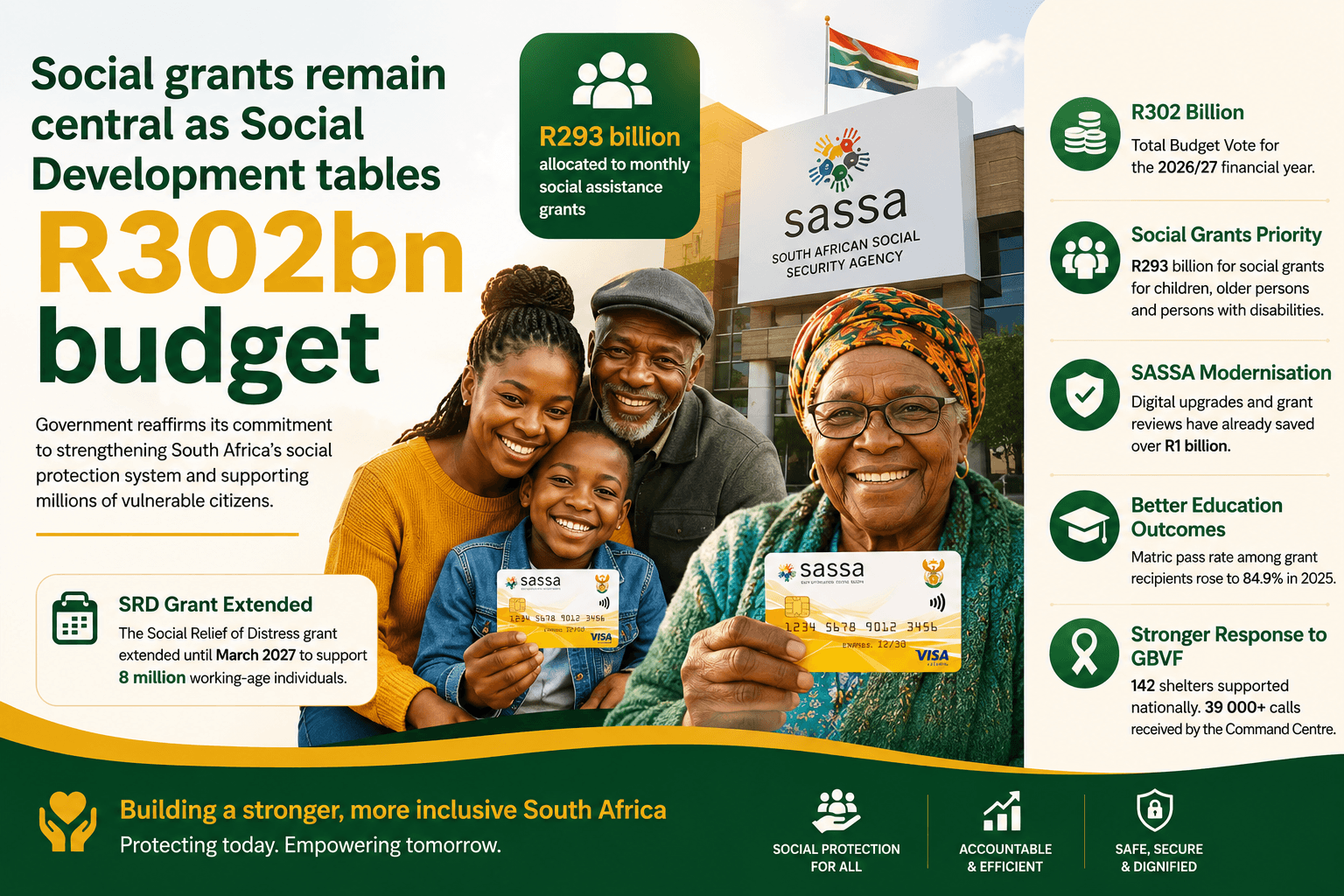
The South African government has officially extended the Social Relief of Distress (SRD) R370 grant until March 2027, confirming continued support for approximately 8 million unemployed South Africans. Acting Social Development Minister Sindisiwe Chikunga tabled Budget Vote 19 in the National Assembly, announcing a landmark R302 billion allocation for the 2026/27 financial year — the largest social development budget in the country’s history.
This guide breaks down exactly what the budget means for your grant, the new grant amounts now in effect, what the SRD extension means for R370 recipients, and what the government is planning beyond 2027.
✍ Updated 29 May 2026 📖 8 min read ✓ Sourced from SAnews, Parliament of SA, National Treasury & BusinessTech
— Acting Minister Sindisiwe Chikunga, National Assembly, May 2026
📋 Table of Contents
- What the R302 Billion Budget Covers
- SRD Grant Extended Until March 2027 — Full Details
- New Grant Amounts — 2026/27 Rates in Full
- Child Support Grant and the Food Poverty Line
- Livelihoods Support — What Replaces SRD After 2027?
- SASSA Modernisation — Biometrics and Savings
- What This Means for You — Action Steps
- Frequently Asked Questions
1 What the R302 Billion Budget Covers
The Department of Social Development’s R302 billion Budget Vote 19 for 2026/27 is the largest ever allocation to social protection in South Africa. Acting Minister Chikunga tabled the budget in the National Assembly in Cape Town, describing it as a response to the ongoing cost-of-living crisis driven by rising food prices, fuel costs, and global geopolitical pressures.
The budget is structured across three main areas:
The department said the budget comes amid “geopolitical tensions worsening the cost of living, including the cost of food, fuel, and other necessities.” Social grants constitute the largest share of spending within the social development function, with total social development function spending projected to rise from R412.2 billion in 2025/26 to R466.4 billion by 2028/29 — a 4.2% increase year-on-year.
2 SRD Grant Extended Until March 2027 — Full Details
The most significant announcement for working-age grant recipients is the formal extension of the Social Relief of Distress (SRD) R370 grant until 31 March 2027. The extension was confirmed by Acting Minister Chikunga when she tabled Budget Vote 19, with R36.4 billion ring-fenced specifically to fund the continuation.
Amount remains R370 per month — no increase
The SRD grant will continue at R370 per month per beneficiary. National Treasury confirmed: “The social relief of distress grant is allocated an additional R36.4 billion to extend payments until 31 March 2027 at the current R370 per month per beneficiary.” No increase to the R370 amount was announced.
~8 million beneficiaries continue to be supported
Approximately 8.2 million working-age South Africans who are unemployed and unable to financially support themselves or their families will continue receiving the SRD grant through to March 2027.
SRD provision fades beyond 2027 — redesign underway
The medium-term budget shows the SRD provision shrinking significantly beyond March 2027 — with only R1.7 billion and R1.2 billion pencilled in for the outer years (2028/29). This signals the government’s intention to replace the SRD with a redesigned livelihood-linked support model rather than extend it indefinitely in its current form.
Basic Income Support policy finalisation in progress
Acting Minister Chikunga confirmed the department has made “considerable progress since the tabling of the Draft Basic Income Support Policy to Cabinet, including the finalisation of the costing models.” A formal Basic Income Support grant — designed to be more permanent than the SRD — is being developed as the long-term replacement.
3 New Grant Amounts — 2026/27 Rates in Full
Finance Minister Enoch Godongwana announced grant increases in the 2026 Budget Speech, effective from April 2026. All grants except the SRD received increases. The increases were welcomed by the department, though Acting Minister Chikunga acknowledged the Child Support Grant remains below the food poverty line.
The increases were funded through the R292.8 billion social grants allocation within the broader R302 billion budget. National Treasury noted the social grant allocation has been adjusted down over the medium term in line with a lower inflation outlook and improved grant targeting and verification, which is expected to yield savings of R2 billion in 2026/27 and R1 billion in 2027/28.
4 Child Support Grant and the Food Poverty Line
While all grants received increases, Acting Minister Chikunga was candid about an ongoing concern: the Child Support Grant of R580 per month per child remains below South Africa’s official food poverty line — the minimum income required to afford basic nutritional needs.
— Acting Minister Sindisiwe Chikunga
Deputy Minister of Social Development Ganief Hendricks echoed the significance of the grants system, saying millions of South Africans rely on the social wage for dignity, hope, and survival. The Child Support Grant is paid to an estimated 13+ million children across South Africa, making it the most widely distributed social grant in the country. Advocacy organisations including Black Sash have long called for the CSG to be increased to at least the food poverty line level — currently above R760 per person per month.
5 Livelihoods Support — What Replaces SRD After 2027?
The government has confirmed it is actively developing a replacement for the SRD grant that links income support to employment pathways — moving away from a pure cash transfer model toward a “livelihoods” approach.
Livelihoods Support Grant — pilot underway
President Cyril Ramaphosa announced in his 2026 State of the Nation Address (SONA) that the SRD grant is being redesigned to align more closely with a work-seeker’s grant. Pilot programmes for the Livelihoods Support Grant are currently running in Gauteng, the Eastern Cape, and Limpopo, with a focus on connecting grant recipients to employment and skills development opportunities.
Basic Income Support — policy finalisation in progress
The Draft Basic Income Support Policy has been tabled in Cabinet, with Acting Minister Chikunga confirming the finalisation of costing models is underway. This would represent a more permanent, rights-based income floor for working-age South Africans — going beyond the temporary relief nature of the SRD grant.
6 SASSA Modernisation — Biometrics and Savings
A significant portion of the budget also funds the continued modernisation of SASSA’s grant administration systems — the same Beneficiary Biometric Enrolment (BBE) system rolling out across all 432 SASSA offices since September 2025.
- SASSA’s biometric and verification systems have already saved more than R1 billion through improved targeting and fraud detection
- Approximately 495,000 beneficiaries flagged via income verification cross-checks with SARS, credit bureaus, UIF, and NSFAS
- The queue management system is being expanded from 113 to 378 offices to reduce waiting times nationally
- Lifestyle audits for SASSA employees in high-risk departments have been introduced to tackle internal fraud
- Projected savings of R2 billion in 2026/27 and R1 billion in 2027/28 from improved grant targeting
7 What This Means for You — Action Steps
If you receive the SRD R370 grant
Your grant is confirmed until March 2027 — no action required
If you are currently approved and receiving your SRD grant, it will continue automatically. Check your status monthly at srd.sassa.gov.za.
Keep your banking details current
Outdated banking details are the most common reason approved SRD grants go unpaid. Update them at srd.sassa.gov.za if your account has changed.
Complete biometric verification if notified
If SASSA has sent you a notification to complete biometric verification, act immediately. Read our full biometric verification guide for step-by-step instructions.
If you receive any other SASSA grant
- Your new grant amount is already in effect from April 2026 — you should have received the increased amount with your April payment
- If you received the old amount in April or May, contact SASSA on 0800 60 10 11 to query your payment
- If you have received a biometric verification notice, complete it urgently — use our biometric guide
- If you receive the Child Support Grant, check our Child Support Grant guide for the latest eligibility and application information
8 Frequently Asked Questions
Check Your SASSA Grant Status Now
Your SRD grant is confirmed until March 2027. Check your status, keep your banking details current, and complete biometric verification if notified.
Check My SASSA Status →✓ SRD extended to March 2027 ✓ R302bn budget confirmed ✓ 26.5 million beneficiaries supported ✓ Free to check: 0800 60 10 11
🚨 Scam Warning
SASSA will never charge you to receive your grant, update your details, or complete biometric verification. Never pay anyone to “secure” your SRD extension or to access the new Livelihoods Support Grant. Report scams to SASSA on 0800 60 10 11 or SAPS on 10111.
📚 Related Guides
- SASSA Biometric Rollout 2026 — What to Do If Your Grant Is Suspended
- SASSA Payment Dates 2026 — Complete Schedule for All Grants
- Child Support Grant 2026 — Eligibility, Amount & How to Apply
- SASSA Banking Details Update 2026 — Step-by-Step Guide
- SASSA SRD Appeal 2026 — Complete Guide
- SASSA e-Life Certification 2026 — How to Complete It Online
