SASSA office distance is the part of the R370 grant story that never makes it into the payment date headlines. For one Northern Cape man, it is more than 20 kilometres, every single time.
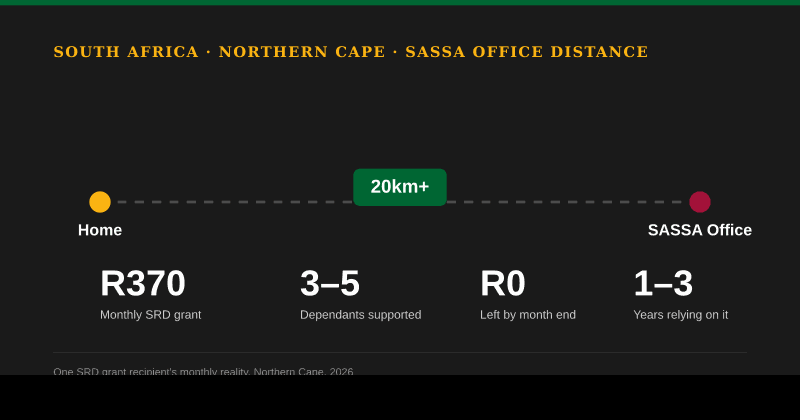
Distance to the nearest SASSA office
Monthly SRD grant, unchanged since 2024
Northern Cape’s official unemployment rate
SASSA office distance rarely gets mentioned in coverage of South Africa’s grant system, which tends to focus on payment dates, review triggers and threshold amounts. For a man in his late forties in the Northern Cape, distance is the whole story. He supports between three and five dependants on a R370 Social Relief of Distress grant, and his nearest SASSA office sits more than 20 kilometres from home.
The money goes straight to food. By the end of every month, there is nothing left in his account. He has held a matric certificate and skills in construction and general labour for years, and he is still job hunting in a province where positions are scarce to begin with. This publication is calling him by the name given in a related account of the same story, Olebogeng Masike, since the original interview did not use his name directly.
This article looks at what SASSA office distance actually costs a rural beneficiary, why the Northern Cape’s version of this problem looks different from other provinces, what SASSA already offers that Masike says he was never told about, and why a pending court case could change how far people like him ever have to travel again.
Why SASSA Office Distance Is Its Own Kind of Poverty
A 20-kilometre round trip is not a minor inconvenience when a person has no vehicle and R370 to last a month. Multiply a single trip across the number of times a beneficiary might reasonably need to visit an office in a year, a review, a query, a document correction, and the true annual cost of SASSA office distance for one household starts to look less like a footnote and more like a recurring line item nobody officially budgets for.
Public transport in rural parts of the Northern Cape is neither cheap nor frequent, and a single taxi fare to reach an office for a review, a query, or a document resubmission can easily eat five or ten percent of a beneficiary’s entire monthly grant in one trip.
This publication has already documented, in detail, how SASSA’s own income threshold for the SRD grant, R624 a month, sits below the official food poverty line. Add a mandatory trip to an office that costs real money to reach, and the arithmetic gets worse before a beneficiary has bought a single meal.
SASSA office distance also compounds every other administrative requirement this publication has covered this year. A grant review, a document resubmission, an appeal against a decline, all of it assumes a beneficiary can physically reach an office within a reasonable window. For someone 20 kilometres out with no reliable transport, that assumption alone can be the difference between a completed review and a lapsed grant, entirely separate from whether the beneficiary’s income actually still qualifies.
There is also a compounding effect specific to households, rather than individuals, that this kind of story tends to underplay. Masike is not budgeting for himself alone. He is stretching R370 across three to five dependants, which means every rand diverted to a taxi fare for a SASSA visit is a rand not spent on food that month for everyone in that household, not just him. Distance does not just cost the beneficiary directly named on the grant. It costs everyone who depends on that grant reaching them.
The Northern Cape’s Particular Version of This Problem
The Northern Cape is South Africa’s largest province by land area and its most sparsely populated by a wide margin. That combination means SASSA offices, like most public infrastructure in the province, are spaced far apart relative to where people actually live.
The province’s official unemployment rate sits at 27.1%, according to Stats SA’s most recent Quarterly Labour Force Survey, actually below the national average of 31.4% and well below harder-hit provinces like the Eastern Cape. That figure alone would suggest the Northern Cape is, relatively speaking, one of the easier provinces in which to find work. What it does not capture is how far apart that work, and the services meant to support people while they look for it, actually sit on the ground.
| Province | Unemployment rate |
| Eastern Cape | 42.5% |
| Free State | 37.2% |
| North West | 35.1% |
| Limpopo | 28.2% |
| Northern Cape | 27.1% |
| Western Cape | 18.1% |
Provincial unemployment rates, Stats SA Quarterly Labour Force Survey, most recent release.
That comparison matters because it shows this is not simply a story about unemployment being unusually severe. It is a story about SASSA office distance and geography compounding a jobs problem that, on paper, is less extreme in the Northern Cape than in several other provinces. A beneficiary in a province with a lower unemployment rate should, in theory, have an easier path off the grant. Distance to services is one of the frictions working against that.
Skills Aren’t the Barrier. Geography Is.
Masike holds a matric certificate and practical experience in construction and general labour, credentials that would open doors in a denser labour market with more employers competing for workers. In much of the Northern Cape, the problem is not a lack of qualifications. It is a lack of employers within reach.
Job hunting itself carries the same distance penalty as accessing SASSA services. Applying in person, attending an interview, or simply following up on an application all assume a level of mobility that a R370 monthly income and a 20-kilometre gap to the nearest town do not comfortably support. A jobseeker without reliable transport is effectively limited to whatever work exists within walking distance, a far smaller pool than the province’s headline unemployment figure suggests.
This is also why the SRD grant, meant as short-term relief, tends to stretch into years for beneficiaries in exactly this position. It is not that Masike or others like him have stopped looking for work. It is that the grant meant to bridge a temporary gap is being asked to bridge a structural one, geography limiting opportunity, that R370 a month was never designed to solve.
What SASSA Already Offers, and What He Says He Never Heard About
SASSA does run a programme specifically designed to reduce the exact SASSA office distance problem described here. The Integrated Community Registration Outreach Programme, ICROP, brings registration and grant services directly into communities rather than requiring a trip to a fixed branch, and this publication has covered its rollout in the Western Cape in detail.
Masike’s account suggests that awareness of ICROP, and of other support programmes beyond the SRD grant itself, has not reliably reached beneficiaries in his part of the Northern Cape. That is a communication and outreach gap layered on top of the physical distance gap, and closing it costs SASSA far less than building new branch offices in every remote settlement.
Digital self-service, which this publication has also covered as an option for reviews and eLife Certification, offers another route that does not depend on ICROP’s outreach schedule reaching a given area. It requires a smartphone and data, both of which carry their own cost, but for a beneficiary with access to either, it can remove the travel requirement entirely for routine tasks like a review or status check.
If You Live Far From a SASSA Office
- Ask at your local municipal or traditional authority office whether ICROP or another SASSA outreach visit is scheduled for your area, rather than waiting to hear about it by chance.
- Where possible, batch errands: complete a review, update contact details and ask about any additional support programmes in a single office visit rather than several separate trips.
- If you have any smartphone access, even briefly through a family member or community centre, check SASSA’s online portal before assuming a trip is unavoidable.
- Keep proof of every visit and every document submitted. A beneficiary who has already made the trip once has a stronger case for flexibility if a follow-up requirement comes up unexpectedly.
- If a review or appointment falls during a period you genuinely cannot travel, contact SASSA’s toll-free line, 0800 60 10 11, to explain rather than simply missing it.
None of these steps close the distance itself. They reduce how many times it has to be crossed, which, for a beneficiary weighing a taxi fare against a week of food, is often the more realistic goal.
The Court Case That Could Change This
This publication has reported in detail on the pending Supreme Court of Appeal case, heard on 25 August 2026, over whether SASSA’s SRD grant system unlawfully excludes eligible people. One of the High Court’s original findings in that case is directly relevant to SASSA office distance: the judge ruled that offering no application channel except an online-only system disproportionately harms applicants who are poor, rural, or otherwise digitally excluded.
If that finding survives the appeal, SASSA could be required to offer a genuine in-person or alternative application channel nationally, not dependent on whichever community ICROP happens to visit in a given month. For a beneficiary like Masike, that would not shorten the physical distance to the nearest office, but it would reduce how often the trip is strictly necessary in the first place.
Common Questions About SASSA Office Distance
Q1. Does SASSA offer any alternative to travelling to a physical office?
Yes, through ICROP mobile outreach visits to communities and through SASSA’s online self-service platform for reviews and certifications, though awareness of both varies significantly by area.
Q2. Why doesn’t SASSA build more offices in rural areas?
Cost and population density are the main constraints. Building and staffing a permanent branch in every remote settlement is far more expensive than mobile outreach or digital service expansion, which is why SASSA has invested more heavily in those two routes instead.
Q3. Could the pending SRD court case change the distance problem?
Indirectly. If the Supreme Court of Appeal upholds the finding that online-only access unlawfully excludes rural applicants, SASSA would need to guarantee an alternative application channel nationally, which would reduce how often a trip to a distant office is strictly required.
Q4. How can I find out if ICROP visits my area?
Contact your nearest SASSA office or the national toll-free line, 0800 60 10 11, and ask directly about scheduled outreach visits to your community.
Q5. Is the R370 SRD grant enough to cover transport costs to a SASSA office?
Not comfortably. A single return trip covering 20 kilometres or more can consume a meaningful share of the monthly grant, on top of an income threshold this publication has already reported sits below the official food poverty line.
SASSA office distance rarely makes a headline on its own. It shows up quietly, inside every other SASSA story this publication covers: the review someone missed because the office was too far to reach twice, the appeal never filed because the taxi fare cost more than the dispute was worth, the ICROP visit that came and went in a neighbouring village nobody heard about in time.
For a man like Masike, R370 a month and a 20-kilometre round trip are not two separate facts about his life. They are the same fact, described from two different angles, and neither the grant amount nor the distance to collect it has moved in years. Fixing one without the other leaves the underlying problem exactly where it started: a support system built around the assumption that reaching it is easy, for people whose whole daily struggle is that it isn’t.
- The South African, “R370 a month, 20km to the SASSA office: Northern Cape man’s reality,” July 2026
- The South African, “The brutal reality of the SRD Grant: Olebogeng Masike’s story,” July 2026
- Statistics South Africa, Quarterly Labour Force Survey, most recent release
- IOL Business Report, “Provincial unemployment rates compared,” February 2026
